Back to Home
· Announcement

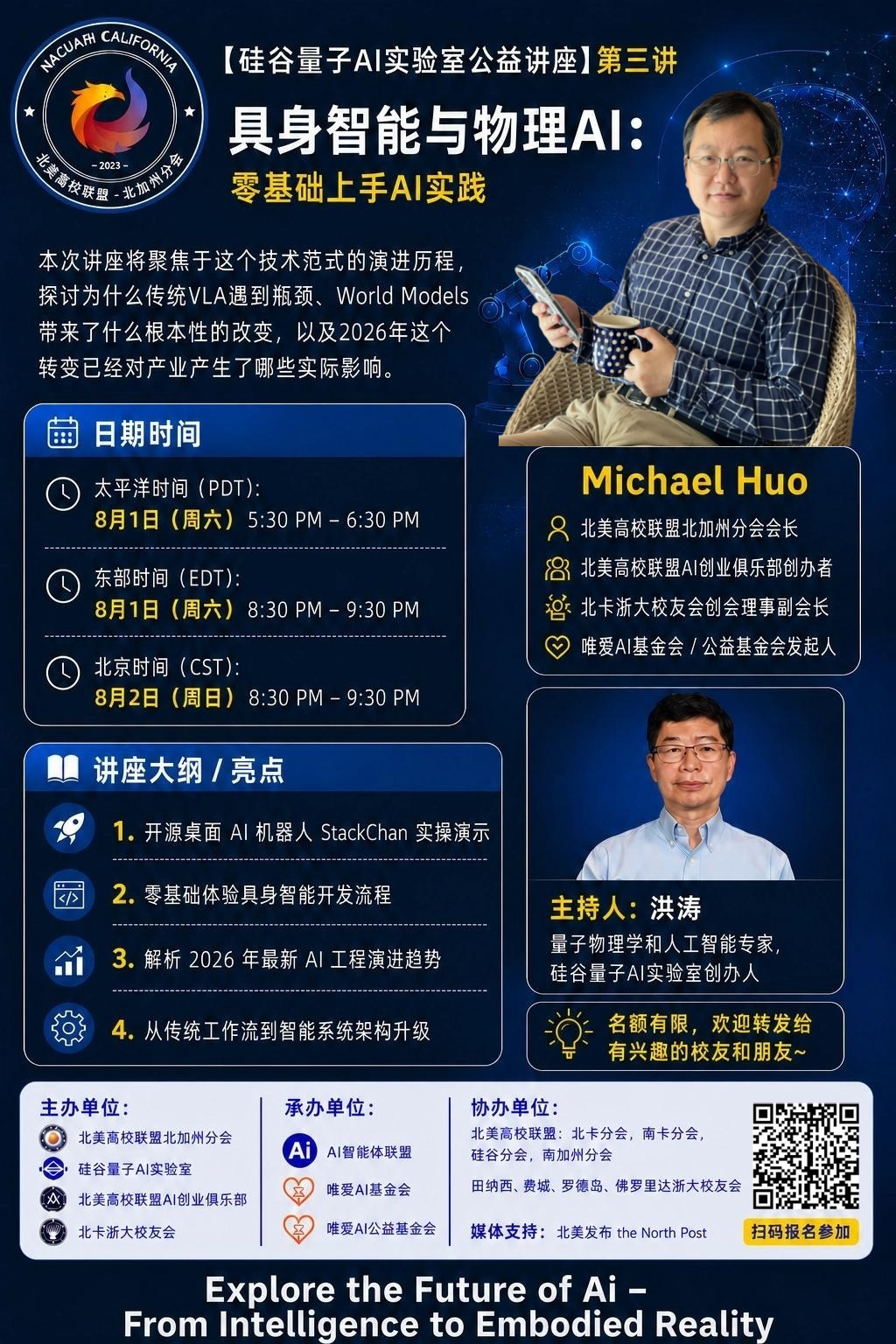
【Public Lecture|Zoom】Embodied Intelligence & Physical AI Lecture 3: Getting Started with StackChan + Loop Engineering to Graph Engineering

Speaker: Michael Huo

Silicon Valley Quantum AI Lab Public Lecture Series

Lecture 3: Getting Started with StackChan Desktop Robot (Hands-on Practice)

Embodied Intelligence & Physical AI Lecture 3 is officially open!

While the first session established overall cognitive framework, and the second analyzed the paradigm shift from VLA to World Models, this session will focus on real-world implementation. Using the open-source desktop AI robot StackChan as a vehicle, we will help even zero-experience listeners quickly get started with Physical AI.

📅 Date & Time

  • Pacific Time (PDT): Aug 1 (Sat) 5:30 PM – 6:30 PM
  • Eastern Time (EDT): Aug 1 (Sat) 8:30 PM – 9:30 PM
  • Beijing Time (CST): Aug 2 (Sun) 8:30 AM – 9:30 AM

Free public Zoom lecture with limited slots. Scan WeChat QR code below to join the group and receive the Zoom invitation link.

🎯 Core Contents

  • Why now is the best time for everyone to start with Embodied AI
  • StackChan demonstration for absolute beginners (voice, expressions, simple Agent tasks)
  • How to make a desktop robot have memory and personality
  • Latest developments (August 2026): Engineering paradigms shift from Loop Engineering to Graph Engineering
  • Actionable steps and common pitfalls for beginners

Perfect for alumni and friends interested in hands-on AI projects. All are welcome to share!

🎓 Embodied Intelligence & Physical AI Lecture Series Comparison

To help you better understand the overall technical progression and choose the learning path that suits you, here is a structured comparison of our 3 sessions:

Session Date Topic Key Question Focus Area Target Audience
Lecture 1 Jun 20 Embodied Intelligence & Physical AI: 2026 Trends & Applications What is it? Where are we today? Foundational concepts & industry landscapes Beginners seeking a comprehensive overview
Lecture 2 Jul 18 Paradigm Evolution from VLA to World Models Why evolve? How does it happen? Deep dive into technology paradigm shifts Professionals looking for logic & trends
Lecture 3 Aug 1 Getting Started with StackChan: Hands-on Practice + Loop to Graph Engineering How to build and implement? Hands-on practice & latest engineering patterns Developers wanting practical experience

📖 Detailed Outlines & Focus Areas

Lecture 1 (Jun 20): Embodied Intelligence & Physical AI: 2026 Trends & Applications

Positioning: Introductory course to build overall cognitive framework

  • Core concepts of Embodied Intelligence and Physical AI
  • Perception-Decision-Action closed-loop systems
  • Introduction to VLA models and World Models
  • NVIDIA ecosystem and digital twins
  • Humanoid robot platform landscapes (Figure, Tesla Optimus, Boston Dynamics, etc.)
  • Application scenarios and current bottlenecks

Summary: Explaining "What is it" to build basic cognitive frameworks across the field.

Lecture 2 (Jul 18): Paradigm Evolution from VLA to World Models

Positioning: Advanced depth session analyzing paradigm transitions

  • Evolution path of LLMs and multimodal models
  • Strengths and constraints of traditional VLA architectures
  • Core concepts and origin of World Models
  • Breakthroughs in World Action Models (WAMs)
  • Latest developments from 2026 WAIC & AGI conferences
  • NVIDIA Cosmos 3 and other key technical updates
  • Humanoid robots deployment case studies
  • Complementary relations and future trends between VLA and World Models

Summary: An in-depth analysis of VLA limitations and World Models strengths, answering "Why & How it evolves."

Lecture 3 (Aug 1): Getting Started with StackChan: Hands-on Practice + Loop to Graph Engineering

Positioning: Practical course emphasizing "anyone can build projects"

  • Why now is the prime time for beginners to enter Embodied AI
  • Introduction to StackChan open-source robot
  • Hands-on Demo: Voice conversation, expression controls, simple Agent tasks, and memory customization
  • Common pitfalls and debugging paths for beginners
  • August 2026 Latest Update: Loop Engineering concepts ➜ Graph Engineering upgrades for engineering scaling
  • Implementing the new paradigm onto your StackChan robot
  • Next action items and recommendations

Summary: Real hardware project practice answering "How to build" and introducing cutting-edge engineering paradigms.

💡 Learning Recommendations & Sequence

  • Absolute Beginners: We highly recommend following the chronological order: Lecture 1 ➜ Lecture 2 ➜ Lecture 3.
  • Hands-on Builders: If you want to dive straight into building your own robot, feel free to skip directly to Lecture 3.
  • Theoretical Explorers: If you want to understand the core logic of Technical Paradigm evolution, pay special attention to Lecture 2.

🤝 Co-Organizers

  • Hosts: Silicon Valley Quantum AI Lab, ZJUAA NC, NACUAAN Northern California Chapter
  • Organizers: AI Agent Alliance, VI AI Foundation, VI AI for Good Foundation, NACUAAN AI Entrepreneurship Club
  • Co-Hosts: NACUAAN North Carolina, South Carolina, Silicon Valley, and Southern California Chapters; ZJUAAs of Tennessee, Philadelphia, Rhode Island, and Florida
  • Media Support: North Alpha Post (北美发布)

💬 Scan WeChat QR Codes to Join

Scan the QR codes below to join our official communication groups to get the Zoom link and lecture slides:

📍 Regional Alumni Groups

加州@北卡浙大校友 加州@北卡浙大校友
德州@北卡浙大校友 德州@北卡浙大校友
华州@北卡浙大校友 华州@北卡浙大校友
佛州@北卡浙大校友 佛州@北卡浙大校友
华府@北卡浙大校友 华府@北卡浙大校友
中国@北卡浙大校友 中国@北卡浙大校友
宾州@北卡浙大校友 宾州@北卡浙大校友
田纳西@北卡浙大校友 田纳西@北卡浙大校友

🤖 Alliance & Lecture Groups

北美高校联盟北加州分会② 北美高校联盟北加州分会②
北美AI智能体联盟技术应用 北美AI智能体联盟技术应用
浙大智能體@AI求是啟真論壇 浙大智能體@AI求是啟真論壇
具身智能物理AI创业公益讲座 具身智能物理AI创业公益讲座
北卡浙大校友 2 北卡浙大校友 2